The short answer
Is a Tokyo sumo show real sumo?
Can you see sumo in Tokyo with no tournament on? Yes, as a show. How a show with pro wrestlers differs from a grand tournament, and who should book it.
Book the Shinjuku sumo show ↗Quick answer
Yes, you can see sumo wrestlers in Tokyo when no tournament is on, but a show is not a tournament. The organiser of the Shinjuku show says plainly that it is not a real tournament, so no result changes anyone's rank. What you get is professional wrestlers demonstrating rituals and sparring while an MC explains, in any month. Grand tournaments, where results do set the rankings, are held in Tokyo in January, May and September.
A grand tournament and the Shinjuku show side by side
| Grand tournament | Shinjuku show | |
|---|---|---|
| Counts for rank | Yes | No |
| Where in Tokyo | Ryōgoku Kokugikan | Central Shinjuku |
| Months | January, May, September | Dates on the booking calendar |
| Try the ring | No | Six guests, by lottery |
The plain answer
A sumo show is real in its parts: the wrestlers, the rituals and the techniques are sumo's own. It is not real in the way the sport itself uses the word. Wikipedia glosses honbasho, the grand tournament, as the main or real tournament, and says the term sets those events apart from display tournaments held on sumo tours, whose results do not affect rankings. A show like Shinjuku's sits outside that system altogether, which is why the organiser tells you up front that it is not a tournament. Think of it as a demonstration with commentary, not a match day, and you will judge it fairly.
What a grand tournament is
The Japan Sumo Association governs professional sumo, called ōzumō, and holds six grand tournaments a year, a pattern in place since 1958. Tokyo hosts three of them, in January, May and September, all at the Ryōgoku Kokugikan. Osaka hosts the March tournament, Nagoya July and Fukuoka November. Each lasts 15 consecutive days, and only these results drive promotion and relegation on the banzuke, the ranking list. That is the sense in which a tournament is real: the results decide who rises and who falls.
How a tournament bout works
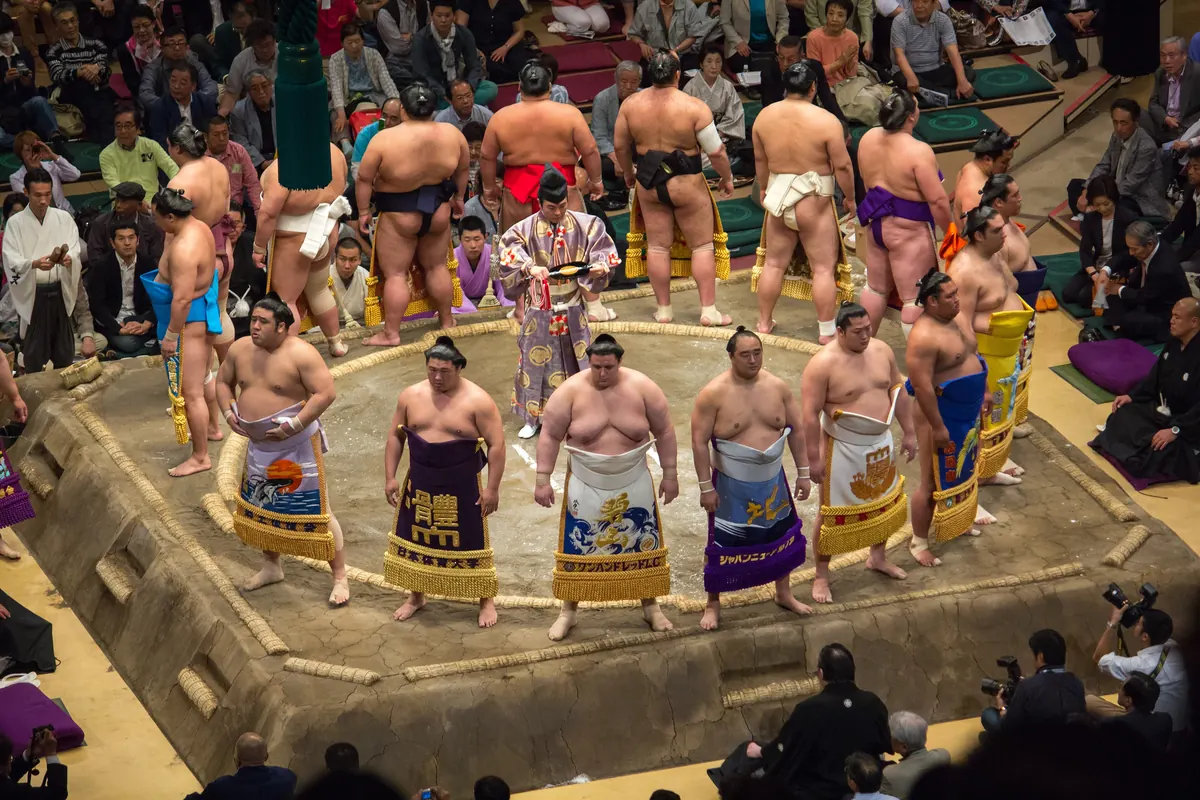
Top-division wrestlers meet one opponent a day, while those in the lower divisions fight seven times in all. A bout ends when one man is driven out of the ring, or when anything but the soles of his feet touches the clay inside it. Wikipedia puts most bouts at under a minute and often just seconds, though the shikiri warm-up before the top division's bouts can run to four minutes. The ring, the dohyō, measures 15 shaku, about 4.55 metres, in diameter.
What the Shinjuku show contains
The organiser describes professional sumo wrestlers showing techniques and rituals, among them shiko, the leg stomp, and salt throwing, followed by live sparring bouts. An English-speaking MC explains the history and the meaning of each ritual, and a welcome drink, which is bottled water, comes with the ticket. After the bouts, up to six guests per show can try the ring against a wrestler, chosen by lottery if more guests want to than there are places. Pictures with the wrestlers are included.
What a show cannot give you
A show cannot give you a ranked bout. No title is decided, no one is promoted, and the wrestlers are not building toward a record. It also compresses sumo into 75 minutes to 1.5 hours with an MC talking you through it, so the slow build of a tournament day is missing. A few guests say they would have liked more bouts and less talk. If the crowd, the build-up and the stakes are what you want from sumo, a tournament seat is the better booking.
What a show gives you that a tournament does not
Explanation, closeness and a chance to take part. At a tournament you watch from a seat in an arena. At the Shinjuku show an MC explains each ritual as it happens, the wrestlers are close enough for the photographs the ticket includes, and the lottery gives six guests a turn in the ring. It also works in any month, so a trip in March, July or December can still include sumo.
Read next: Shinjuku sumo show: what to expect
Where the rituals come from
The Japan National Tourism Organization writes that sumo dates back around 2000 years, to a Shinto rite connected with praying for a good harvest. That origin explains what you see. Wrestlers throw salt, which Wikipedia describes as a symbolic cleansing of the ring, and the referee dresses in garb very similar to a Shinto priest's. Wikipedia adds that in 1684 sumo was allowed in Edo for charity events on shrine grounds, the first sanctioned tournament being at Tomioka Hachiman Shrine. A show keeps the ritual and drops the rankings.
Read next: Sumo rituals, explained before a show
Using a show to prepare for a tournament
If your trip includes January, May or September, plan the tournament first. The Japan Sumo Association sells tickets through its English site, and its ticket service, Ticket Oosumo English, runs through PIA. The tourism organisation says box seats fit up to four people, arena seats on the second level are the more affordable choice, and ringside seats are limited. It advises reserving as early as possible, particularly for a box seat. A show on another evening then gives you the vocabulary, so you know what shiko and shikiri are before the first bout.
Read next: Watching a sumo tournament in Tokyo
A third way: morning practice
Sumo stables, called heya, are where wrestlers live and train, and many are near the Ryōgoku Kokugikan. The tourism organisation says visitors can watch practice under the stable master, but casual, spontaneous visits are not encouraged and some travel agencies arrange tours for small groups. Wikipedia adds that rules on group size and advance notice vary by stable. Practice is the least staged of the three ways to see sumo, and the hardest to arrange on your own.
Read next: Sumo morning practice for visitors
How to choose in one minute
Start with your dates. If you are in Tokyo in January, May or September, a tournament seat is the first thing to price up, and a show is a bonus. In any other month a show is the realistic choice, and morning practice is the stretch goal if you can arrange it. If you know little about sumo, the show's explanation helps whichever you book later. If you already follow the sport, a tournament is the better use of a day.
- January, May or September: look at a tournament first, then add a show if you want the rituals explained.
- Any other month: a show is the way to see wrestlers in a ring in Tokyo.
- First time seeing sumo: a show, so the rituals make sense before any tournament.
- Long-time follower of the sport: a tournament seat.
Who this isn't for
Skip the Shinjuku show if you came for the sport's stakes. It is a demonstration with an MC, an audience game and photographs, built for visitors who want to understand sumo rather than follow a tournament. People who like the rituals but not the audience participation can still book, because watching is enough and only six guests per show go into the ring.
- Anyone who wants ranked bouts or a title decided.
- Visitors who prefer to watch in silence, without an MC or audience taking part.
- Guests who want a long programme of bouts rather than demonstration and talk.
- Anyone likely to arrive late, because the front desk may not admit late guests.
Frequently asked questions
Is a Tokyo sumo show real sumo?
The wrestlers, rituals and techniques are sumo's own, but a show is not a tournament. The organiser says so plainly, and no result changes anyone's rank. Only the grand tournaments set the rankings.
When are the sumo tournaments in Tokyo?
In January, May and September, at the Ryōgoku Kokugikan. Tokyo hosts three of Japan's six grand tournaments each year; the others are in Osaka, Nagoya and Fukuoka. Check the Japan Sumo Association's English site for dates and tickets.
Do I need to know sumo before the Shinjuku show?
No. An English-speaking MC explains the history, the rituals and the techniques as the wrestlers perform them, so a first-timer can follow.
Can I see a tournament and a show on the same trip?
Yes, and the order helps. A show explains the rituals and vocabulary that a tournament takes for granted. If your dates include January, May or September, look at tournament seats first, because the tourism organisation advises reserving early.
Can I watch sumo practice instead of a show?
Sometimes, with arrangements. The tourism organisation says casual visits to stables are not encouraged and some travel agencies arrange small-group tours. Rules vary by stable.
How long is the Shinjuku show?
Plan on 75 minutes to 1.5 hours. Pick a date and the calendar lists when it begins.
Sources